Wednesday, November 12, 2025

Andrea Lucas Named Chair of EEOC

Last week, the Equal Employment Opportunity Commission announced that Andrea R. Lucas has been designated by President Trump as Chair of the Commission. She has been a member of the Commission since 2020. She was confirmed by the Senate in July 2025 to serve a second term on the Commission. She has been serving as Acting Chair of the EEOC since January of this year. (Background.) According to Lucas' biography on the EEOC website:

She prioritizes evenhanded enforcement of civil rights laws for all Americans, including by rooting out unlawful DEI-motivated race and sex discrimination; protecting American workers from anti-American national origin discrimination; defending the biological and binary reality of sex and related rights, including women’s rights to single-sex spaces; protecting workers from religious bias and harassment; and remedying other areas that have been historically under-enforced by the agency.

On Oct. 7, the U.S. Senate confirmed Brittany Panuccio as an EEOC member, restoring sufficient members for a quorum. The EEOC lost its quorum when President Trump removed two Biden-appointed Commissioners in January. (Background.)

The EEOC administers federal laws barring employment discrimination, including discrimination on the basis of religion.

Religious Based Proxy Advisors Challenge New Texas Regulatory Law

Texas S.B.2337 enacted by the Texas legislature earlier this year imposes new disclosure requirements on proxy advisory services that provide advice or research to institutional investors on how to vote on shareholder proposals if the service bases its advice in whole or part on non-financial factors such as environmental and social goals, corporate governance, or diversity, equity or inclusion. Suit was filed this week in a Texas federal district court challenging the law on free speech and vagueness grounds. Two of the plaintiffs have a specific religious focus. A third focuses on sustainability issues.  According to the complaint (full text) in Interfaith Center on Corporate Responsibility v. Paxton, (WD TX, filed 11/10/2025)

6. Plaintiff Interfaith Center on Corporate Responsibility (ICCR) is a coalition of investors who believe their faith or their values should—and as fiduciaries must—guide their investing decisions, including their investment stewardship. Plaintiff United Church Funds (UCF) is a faith-based organization that provides investment services to United Church of Christ (UCC) churches and other faith-based nonprofit organizations nationwide.  Plaintiff Ceres is a nonprofit organization dedicated to the notion that accounting for sustainability is a financial imperative for companies.

The complaint goes on to contend: 

7. The State of Texas can disagree with ...  Plaintiffs ICCR’s and UCF’s view that their values and religious beliefs are relevant to investment-related decisions. What it cannot do is compel Plaintiffs to speak in furtherance of Texas’s views about these issues. 

75. ... SB 2337’s stated goal of “prevent[ing] fraudulent or deceptive acts and practices in this state,” S.B. 2337 § 1(4), is mere pretext for regulating disfavored views, rendering the Act’s stated interest unlikely to be genuine....

80. The Act discriminates based on the content of speech and is not narrowly tailored to serve a compelling state interest and thus violates the First Amendment.  

81. Because it subjects only certain speech with a certain viewpoint to rigorous regulation, SB 2337 discriminates based on viewpoint, in violation of the First Amendment. Worse, it compels private speakers to adopt and parrot the government’s viewpoint on hotly contested topics and to align with management views.

Baptist News Global reports on the lawsuit.

Tuesday, November 11, 2025

Texas AG Sues School District to Require Posting of 10 Commandments

Last week, Texas Attorney General Ken Paxton filed suit in a Texas state trial court against the Galveston School District and its board members seeking to order them to display copies of the Ten Commandments in every classroom as mandated by Texas law. The complaint (full text) in State of Texas v. Galveston Independent School District, (TX Dist. Ct. filed 11/7/2025) reads in part:

Defendants are openly violating the law in Texas. In order to prevent irreparable harm to the State of Texas’s interests and to bring Defendants back into the bounds of the law, the State of Texas requests temporary and permanent injunctive relief from this Court. 

In August 2025, a Texas federal district court enjoined eleven school districts from complying with the Texas statute that requires posting of the Ten Commandments in classrooms. (See prior posting.) The Galveston district is not one of those eleven. Attorney General Paxton has directed school districts that were not defendants in that case to comply with the display requirement. (See prior posting).

Friendly Atheist blog discusses the lawsuit.

Monday, November 10, 2025

Supreme Court Denies Review in Same-Sex Marriage Case

In a closely watched case, the U.S. Supreme Court today denied review in Davis v. Ermold, (Docket No. 25-125, certiorari denied 11/10/2025) (Order List.)  In the case, the U.S. 6th Circuit Court of Appeals upheld a $100,000 damage award to a same-sex couple who were refused a marriage license by Rowan County, Kentucky Clerk Kim Davis who had religious objections to same-sex marriage. The certiorari petition asked the Court to decide whether she, as a public official, had a First Amendment free exercise defense to a claim for damages for emotional distress stemming from her refusal. More broadly, it asked the Court to overrule Obergefell v. Hodges which gave constitutional protection to same-sex marriage. AP reports on the court's action.

Supreme Court Hears Arguments Today in RLUIPA Damages Case

The Supreme Court hears oral arguments this morning in Landor v. Louisiana Department of Corrections. At issue in the case is whether an action for damages lies under the Religious Land Use and Institutionalized Persons Act in a suit against a prison official in his personal capacity. Plaintiff, a Rastafarian, had his dreadlocks forcibly shaved by prison guards.  The Supreme Court has previously held that a damage action under RFRA can be brought against federal prison personnel, but the U.S. 5th Circuit Court of Appeals held that it would violate the Spending Clause to recognize a similar remedy under RLUIPA, which is a statute based on Congress' Spending Clause authority. Oral arguments can be heard live at 10:00 AM at this link. Links to all the briefs and pleadings in the case, as well as related material can be found on the SCOTUS blog case page for the case. A transcript and audio of the full oral arguments will be available later today on the Supreme Court's website here.

UPDATE: Heare are the links to the transcript and recording of oral arguments in the case. And SCOTUSblog has a review of the oral arguments.

6th Circuit En Banc: Banning Student-on-Student Use of Biological Pronouns Violates Free Speech Rights

In Defending Education v. Olentangy Local School District Board of Education, (6th Cir., Nov. 6, 2025), the U.S. 6th Circuit Court of Appeals in a 10-7 en banc decision held that the free speech rights of public-school students are infringed when the school prohibits them from calling fellow-students who are transgender by their biological pronouns rather than the pronouns preferred by their fellow students.  A 3-judge panel of the 6th Circuit had reached an opposite conclusion. (See prior posting.) Plaintiff students and parents hold religious beliefs that gender is immutable. Opinions in the en banc case span 112 pages. The en banc court's majority opinion said in part:

A school district may not restrict personal speech on matters of public concern unless the speech would “materially and substantially disrupt” school activities or infringe the legal “rights of others” in the school community.  Tinker v. Des Moines Indep. Cmty. Sch. Dist., 393 U.S. 503, 513 (1969).  In this case’s current posture, the school district has fallen far short of meeting this demanding standard.  It introduced no evidence that the use of biological pronouns would disrupt school functions or qualify as harassment under Ohio law....

 ... [T]he School District has regulated personal expression—the use of biological pronouns to convey a student’s scientific and religious beliefs—that addresses a “sensitive topic of public concern.” ... As part of the broader debate over transgender rights, the question whether speakers should use preferred pronouns to refer to transgender individuals—and whether we should treat the commonplace (and non-antagonistic) use of biological pronouns as proper or offensive—has stirred a “passionate political and social debate” in our society....

... [T] the School District has not just entered this policy debate.  It has taken a side.  The School District has “targeted” a speaker’s use of biological pronouns as improper while allowing students to use preferred pronouns (no matter how novel)....

... The School District is right that schools may bar abusive “invective” that targets “specific” students—whether transgender students, religious students, female students, Hispanic students, or any others.... That is, a school could bar a student from abusively ridiculing a transgender classmate’s “physical characteristics” in the same way it could bar a student from abusively ridiculing a smaller student’s physical characteristics.... But the School District is wrong to treat the use of biological pronouns alone as analogous to this abusive invective.  Defending Education’s members want to use biological pronouns not because they seek to ridicule others but because they want to speak what they view as the truth.... 

Ohio law defines “harassment, intimidation, or bullying” to cover speech directed at another student only if the speech both “[c]auses mental or physical harm to the other student,” and “[i]s sufficiently severe, persistent, or pervasive that it creates an intimidating, threatening, or abusive educational environment for the other student.”  Ohio Rev. Code § 3313.666(A)(2)(a).  And the School District has offered no evidence that the commonplace use of biological pronouns would create an intimidating, threating, or abusive environment....

Judge Batchelder filed a concurring opinion, saying in part:

... [E]ven if the School District were to produce overwhelming evidence of disruption, that evidence would still not justify the compelled-speech or viewpoint-discrimination aspects of its preferred-pronoun policies.

Judge Kethledge filed a concurring opinion, saying in part:

 ... [T]o determine whether the plaintiffs here should prevail on their First Amendment claim, we should begin with the right question:  namely, whether the historic common law would have subjected a student to punishment (as a matter of public law or private) for referring to a classmate with biological pronouns that the classmate had insisted the student not use.  Considering the speech alone, the answer is likely no.  For one thing, as noted above, offense or dignitary harm was not cognizable at law....  And the right to express one’s opinions in good faith would almost certainly protect the speech at issue here....

A final point is hortatory rather than legal.  That the law permits certain action does not mean that an individual should necessarily engage in it....

Judges Thapar and Nalbandian filed a concurring opinion, saying in part:  

In the end, the School District’s policy “mandates orthodoxy, not anti-discrimination,” and fails to recognize that “[t]olerance is a two-way street.”...  The District chose a side in a hotly contested debate and tried to squelch the opposing viewpoint by imposing an ideological speech code.  When it did so, it unlawfully discriminated based on viewpoint.  And while we appreciate the majority’s thoughtful Tinker approach, we worry that students’ rights to speak freely on important matters of public interest should not hang in the balance while district courts perform ad hoc inquiries into how “disrupt[ive]” they find the students’ viewpoint....

Judge Bush filed a concurring opinion, saying in part:

Rather than employ the traditional monsieur (for a man) and madame or mademoiselle (for women) or use longstanding aristocratic titles..., the French revolutionaries replaced those words with the masculine citoyen or feminine citoyenne (both translated as “citizen”) to refer to all men and women, respectively, regardless of station....  

Like the French revolutionaries, communists also sought to revolutionize forms of address for political ends.  Communist regimes strongly encouraged and sometimes mandated use of “comrade” instead of traditionally employed honorifics to refer to another person, just as the French revolutionaries insisted on the use of “citizen.”  That was not surprising.  “[T]he history of authoritarian government . . . shows how relentless authoritarian regimes are in their attempts to stifle free speech . . . .” ...

Governments in the United States—federal or state—never operated that way.  Our Constitution forbids mandatory use of certain titles to refer to others....

American history and tradition uphold the majority’s decision to strike down the school’s pronoun policy.  Over hundreds of years, grammar has developed in America without governmental interference.  Consistent with our historical tradition and our cherished First Amendment, the pronoun debate must be won through individual persuasion, not government coercion.  Our system forbids public schools from becoming “enclaves of totalitarianism.”

Judge Stranch joined by Judges Moore, Clay, Davis, Mathis, Bloomekatz and Ritz, filed a dissenting opinion, saying in part:

In this case, the School District has repeatedly affirmed that the children of Defending Education members will have the right to express beliefs about transgender identities.  Those children will be permitted to express the view that sex is immutable.  But it is not viewpoint discrimination to require those students to share those beliefs in a manner that does not disrupt the education of others....

The District made clear in its Policies that the purpose of the ban on intentional use of non-preferred pronouns is to prevent disruption in the form of trauma to transgender or nonbinary students of a degree likely to hamper those students’ ability to learn.  Evidence of that purpose was before the district court.....

Though the record satisfied Tinker’s requirement that the School District’s forecast be reasonable, the majority opinion concluded otherwise, positing and applying a new approach:  that “the closer the speech resembles political expression at the First Amendment’s core, the more evidence a school must present of the potential disruption or violation of rights.”...

... Existing precedent provides educators—those most attuned to the issues in their schools—with a reasonable level of agency to develop productive, civilized educational settings while protecting both student rights and student safety.

Columbus Dispatch reports on the decision.

Recent Articles of Interest

From SSRN:

From SmartCILP:

Sunday, November 09, 2025

En Banc Review Rejected on Denial of Interlocutory Appeal of Church Autonomy Issue

In O'Connell v. U.S. Conference of Catholic Bishops, (DC Cir., Nov. 6, 2025), the DC Circuit Court of Appeals, over one dissent, denied en banc review of a panel's refusal to allow an interlocutory appeal of a ruling in which the district court refused to dismiss a case against the Conference of Bishops (USCCB). Plaintiff in the case charged the USCCB with fraudulent solicitation of donations, claiming that it misrepresented where money donated to Peter's Pence Collection would go. USCCB sought dismissal of the suit on church autonomy grounds. The district court refused. A 3-judge panel of the DC Circuit in O'Connell v. U.S. Conference of Bishops, (DC Cir., April 25, 2025), held that the district court's ruling could not be appealed until the district court had rendered a final decision in the case. The panel said in part:

... [I]t seems clear that the [Supreme] Court confirmed the church autonomy doctrine is not jurisdictional; it is an affirmative defense. And, like any other defense, a defense based on church autonomy can be adequately addressed after trial.

In last week's decision, the DC Circuit en banc agreed. While no opinion for the majority accompanied the Order denying en banc review, two of the Court's judges, Judge Walker and Judge Edwards, each filed a separate opinion concurring in the decision. Judge Edwards said in part:

Indeed, the idea that there could be collateral order review in a case of this sort would mean that there could be a constant stream of interlocutory review petitions every time a litigant merely asserts a religious privilege during trial (which could happen every time the district court issued an evidentiary or discovery order). You could have interlocutory review after interlocutory review after interlocutory review, endlessly. This makes no sense in light of the final decision rule, especially given that a religious organization always retains the right to appeal any final judgment (or preliminary injunction) issued against it before it is required to take any contested action. 

Neither the Supreme Court nor any circuit has ever expanded the collateral order doctrine to categorically cover alleged denials of a church autonomy defense.

Judge Rao filed a 31-page dissenting opinion, saying in part:

The district court erred by invoking neutral principles of law to reject a church autonomy defense. Instead, the district court was required to assess whether the Catholic Church’s administration of Peter’s Pence, a major giving initiative, was within the constitutionally protected sphere of church autonomy. Because the solicitation and expenditure of religious donations clearly implicate matters of faith, doctrine, and internal governance, O’Connell’s lawsuit should have been dismissed....

... [T]he Religion Clauses protect a sphere of church autonomy from state interference. Because such interference can include the very process of judicial inquiry, the church autonomy defense is best understood as a constitutional immunity from suit....

The facts of this case typify the stakes for religious liberty when a church autonomy defense is denied. O’Connell, an individual congregant, challenges the Catholic Church’s use of his donation and asks the Bishops to disclose lengthy donor lists, records of amounts received, and the ways in which contributions made under Peter’s Pence were deployed. Describing the litigation demonstrates how it plainly encroaches on the heartland of matters committed to the Church’s exclusive sphere, including ecclesiastical decisions about how to solicit, manage, and use religious donations. Without immediate interlocutory review, the Bishops have no meaningful route to protect their independence from judicial intrusion into matters of faith, doctrine, and internal governance. Requiring the Bishops to go forward with this litigation comports with neither the Constitution nor the Supreme Court’s precedents....

Friday, November 07, 2025

Supreme Court: Trump Administration Rules on Passport Gender Markers Can Go into Effect While Appeals Move Forward

In Trump v. Orr, (Sup. Ct., Nov. 6, 2025), the U.S. Supreme Court by a 6-3 vote granted an emergency stay of a preliminary injunction that had been entered by a Massachusetts federal district court.  The district court had enjoined, pending appeal, enforcement of the Trump Administration's policy of requiring U.S. passports to display the sex assigned to the passport holder at birth rather than the sex marker that matches their current gender identity. The challenged policy was put in place in compliance with a 2025 Executive Order on ... "Restoring Biological Truth to the Federal Government."   In staying the injunction, the Supreme Court's majority said in part:

Displaying passport holders’ sex at birth no more offends equal protection principles than displaying their country of birth—in both cases, the Government is merely attesting to a historical fact without subjecting anyone to differential treatment. And on this record, respondents have failed to establish that the Government’s choice to display biological sex “lack[s] any purpose other than a bare . . . desire to harm a politically unpopular group.”

Justice Jackson, joined by Justices Sotomayor and Kagan filed a dissenting opinion, saying in part:

What the Government needs (and what it does not have) is an explanation for why it faces harm unless the President’s chosen policy is implemented now....

 ... [The government] provides no evidence of harmful confusion or other problems caused by transgender Americans who are using passports with sex markers corresponding to their current gender identity.  To the contrary, as the plaintiffs’ experiences demonstrate, it is gender-incongruent passports that cause confusion and fail to provide a meaningful basis for identification.

 As for the Government’s suggestion that the President is harmed by not being able to impose a uniform definition of sex across various regulatory schemes, that assertion is just another species of the far-fetched contention that the President must be injured whenever he is prevented from doing as he wishes....

Politico reports on the decision.

FACE Act Suit Filed Against Anti-Israel Agitators

Suit was filed this week in a California federal district court against nine named defendants and 40 unnamed defendants alleging disruption of interfaith and Christian religious services by anti-Israel agitators. The complaint (full text) in Christian and Jewish Alliance, Inc. v. Brunner, (SD CA, filed 11/4/2025), alleges violation of provisions of the FACE Act which impose civil liability for physically interfering with the exercise of the 1st Amendment right to religious freedom at a place of worship.  It also alleges a claim for trespass. The complaint reads in part:

As worshipers have gathered at three separate events this year, a mob has targeted Plaintiffs The Mission Church .. of Carlsbad and The Christian & Jewish Alliance ... of the San Diego area, interfering with their worship services, intimidating their members and guests, and obstructing their access to gather safely. This mob targeted the Church and the Alliance due to the sincere religious beliefs of their members that require support for Israel. Plaintiff Ruth Mastron, a Jewish resident of Oceanside, was assaulted as she attempted to enter one of these events.

First Liberty Institute issued a press release announcing the filing of the lawsuit.

Suit Seeking Damages for False Prediction of the Rapture Is Dismissed Under Anti-SLAPP Law

 In March 2025, a New York resident filed suit in a Connecticut state trial court against a Christian YouTube channel and the preacher who appears on it claiming that the preacher's prediction of imminent coming of the rapture caused plaintiff severe emotional distress and mental anguish. The complaint (full text) in Diver v. Cote, (CT Super. Ct., filed 3/20/2025), alleged claims for infliction of emotional distress, fraud and for violation of the state's Unfair Trade Practices Act. Defendants sought dismissal of the lawsuit under Connecticut's anti-SLAPP law which allows quick dismissal of unmeritorious suits that, among other things, challenge defendant's exercise of his free speech rights when defendant's speech relates to a "public figure". Now, in Diver v. Cote, (CT Super. Ct., Nov. 3, 2025), the court dismissed this suit and a related one under the anti-SLAPP law, saying in part:

... [Defendants] have shown ... that the complaints in both actions are based on the exercise of their right of free speech on matters of public concern, that is, issues related to health, community well-being and a public figure; namely Jesus Christ. §52-196a(a)(1). The defendants' speech was made in a public forum; namely You Tube websites open to the public as required by §52-196a(a)(2).

Inside Investigator covered the lawsuit here and here.

Thursday, November 06, 2025

Religious College Challenges Exclusion from Chicago's Student Teacher Program

Suit was filed this week in an Illinois federal district court by the Moody Bible Institute challenging the Chicago Board of Education with excluding its students from participating in the Chicago student teacher program in violation of the Constitution and of state law. The complaint (full text) in Moody Bible Institute of Chicago v. Board of Education of the City of Chicago, (ND IL, filed 11/4/2025), alleges in part:

... Chicago Public Schools insists that Moody sign two agreements that contain provisions prohibiting Moody from employing only those who share its religious beliefs and agree to comply with its standards of Christian conduct (the “Employment Provisions”)....

Chicago Public Schools has allowed other universities and colleges to participate in the Pre-Service Teaching Program even though they have similar hiring practices to Moody....

Plaintiff alleges that this violates their rights under the First Amendment's religion and speech clauses, the 14th Amendment's equal protection clause and the Illinois Religious Freedom Restoration Act.

ADF issued a press release announcing the filing of the lawsuit.

Priest's Defamation Suit Dismissed on Ecclesiastical Abstention Grounds

In Catholic Diocese of Richmond v. Smalls, (VA App, Nov. 5, 2025), a Virginia state appellate court dismissed on ecclesiastical abstention grounds a defamation suit by a priest serving in the Diocese of Belize.  The Diocese of Richmond included plaintiff's name on a list of priests who had credible and substantiated allegation of sexual abuse of a minor.  The allegations against plaintiff occurred while he was a seminarian in the Richmond Diocese. The court said in part:

It is clear that the definition used to determine that there was a credible and substantiated allegation against Smalls of sexual abuse involving a minor includes references to religious precepts.  The definition discusses sexual abuse in terms of a violation of the Sixth Commandment.  It also provides that clergy who possessed, acquired, or distributed “pornographic images of minors under the age of fourteen” committed sexual abuse, but does not define “pornographic images.”  But if there is doubt as to whether such an offense has occurred, bishops are directed to reference writings of moral theologians.  Smalls’s defamation claim thus rests on the falsity of a statement that is based on the application of a specific religious definition of sexual abuse.  “[C]ivil courts cannot adjudicate defamation claims when the truth of the statements in question turns on ecclesiastical law.” ...

Because Smalls’s claim for defamation cannot be resolved on neutral secular principles, the circuit court was without subject matter jurisdiction to hear the case....

Wednesday, November 05, 2025

Texas Voters Approve Parental Rights Amendment

Texas voters yesterday by a vote of 70% to 30% adopted an amendment to the state Constitution providing:

To enshrine truths that are deeply rooted in this nation's history and traditions, the people of Texas hereby affirm that a parent has the responsibility to nurture and protect the parent's child and the corresponding fundamental right to exercise care, custody, and control of the parent's child, including the right to make decisions concerning the child's upbringing.

Trump Calls Out Jews Who Vote for Mamdani

 In a Truth Social post (full text) yesterday, President Donald Trump said:

Any Jewish person who votes for Zohran Mamdani, a proven and self-professed JEW HATER, is a stupid person!!!

Axios reports on the President's remarks.

Trump Declares Nigeria a "Country of Particular Concern"

 On October 31, President Trump announced on Truth Social (full text) that he is designating Nigeria as a "Country of Particular Concern" under the International Religious Freedom Act. He said in part:

... When Christians, or any such group, is slaughtered like is happening in Nigeria (3,100 versus 4,476 Worldwide), something must be done.... We stand ready, willing and able to save our great Christian population around the World.

In a follow-up Truth Social post on November 1 (full text), President Trump said:

If the Nigerian Government continues to allow the killing of Christians, the U.S.A. will immediately stop all aid and assistance to Nigeria, and may very well go into that now disgraced country "guns-a-blazing"...

The Pillar has more details.

Tuesday, November 04, 2025

Presidential Message on All Saints Day

On November 1, President Trump issued a Presidential Message on All Saints Day (full text). It reads in part:

On All-Saints’ Day, the First Lady and I join Christians across our Nation in celebrating the saints who have gone before us and now share in the glory of God.  Their examples remind us that the strength of our country rests in the goodness of its people—and that through faith and virtue, our Nation can endure in liberty and truth.

From our earliest days, the United States has drawn inspiration from holy men and women whose witness shaped our people and deepened our faith.  The Blessed Virgin Mary, Patroness of the United States, has long been honored as a symbol of grace for our country.  Saint Frances Xavier Cabrini poured out her life in service to the most poor and needy among us; Saint Elizabeth Ann Seton formed generations through her schools of faith and learning; and Saint John Neumann led his flock with humility, courage, and unrelenting devotion.  Their example, and those of all the saints, demonstrates that faith transforms nations as surely as it transforms hearts.

Our country has long cherished the freedom of religion that allows faith such as theirs to flourish.  My Administration is committed to defending this sacred right, upholding the freedom of every believer to worship, speak, and live according to their beliefs.  We are standing firm against those who seek to persecute or marginalize people of faith, protecting churches, schools, and communities from religious discrimination, and ensuring that Christian values maintain their rightful place at the center of American life.  As we remember the perfect example of Christ and the legacy of His saints, we renew our promise to live as one Nation under God, defending liberty, seeking justice, and striving always toward the good that His truth reveals.

School May Bar Teacher from Hanging Crucifix on Classroom Wall

In Arroyo-Castro v. Gasper, (D CT, Nov. 3, 2025), a Connecticut federal district court in a 54-page opinion rejected claims of a public middle-school teacher that her free speech and free exercise rights were violated when she was disciplined for hanging a crucifix on a classroom wall near her desk.  The court said in part:

... Ms. Castro acted pursuant to her job duties as a teacher when she decorated the walls of her classroom with items the students would see during instructional time. The question is whether Ms. Castro was doing otherwise when she hung items she calls “personal expressive items” on the wall, including the crucifix. Ms. Castro specifically states that posting such items makes the classroom environment more conducive to learning because the items humanize the teacher to their students. In that way, therefore, Ms. Castro was acting pursuant to her official duties as a teacher by displaying the items....

Accepting Ms. Castro’s argument that teachers have a First Amendment free speech right to post “personal expressive items” related to matters of public concern on classroom walls—where they are visible to students during instructional time—would mean the District could not control the messages conveyed to students while the students are required to be present in the classroom for learning. Instead, with respect to each such item a teacher posted on the classroom wall, the District would need to engage in a Pickering balancing analysis and could prohibit only those items that are sufficiently disruptive.  

... I conclude that Ms. Castro is unlikely to prevail on her claim that her display of the crucifix on the wall of the classroom constitutes speech as a private citizen rather than pursuant to her job duties as a teacher. Therefore, I conclude she is not likely to prevail on her free speech claim....

Ms. Castro says that she “sincerely believes that her religion compels her to display her crucifix, not hide it under her desktop” and “[s]tifling her religious expression through concealment of the crucifix ‘would be an affront to [her] faith....  

I have already concluded that the crucifix display on the classroom wall was pursuant to Ms. Castro’s official duties and is therefore speech attributed to the District. The speech is thus, for constitutional purposes, the government’s own speech....

Defendants argue that allowing the crucifix to remain on the classroom wall would constitute a violation of the Establishment Clause or, at the very least, expose the District to a risk of liability for such a violation....

Based on the existing record, I conclude that Ms. Castro is unlikely to show that Defendants did anything other than make “a reasonable, good faith judgment” that permitting Ms. Castro to hang the crucifix on the classroom wall during instructional time “runs a substantial risk of incurring a violation of the Establishment Clause.... I agree with Defendants, therefore, that a preliminary injunction should not issue....

As noted, under binding Second Circuit cases, the District must be afforded some leeway in balancing the free exercise rights of its employees and the risk of an Establishment Clause violation.... Unlike the coach’s prayer in Kennedy, the crucifix display is a religious message on the classroom wall broadcast to a “captive audience” of students required to be in the classroom. ...

First Liberty Institute issued a press release announcing the decision.

[Thanks to Eugene Volokh via Religionlaw for the lead.] 

Village's Zoning Law for Places of Worship Is Unconstitutional

In Lubavitch of Old Westbury, Inc. v. Incorporated Village of Old Westbury, New York, (ED NY, Oct. 30, 2025), a New York federal district court granted partial summary judgment to a Lubavitch organization that wants to build a Chabad House on land in Old Westbury. Plaintiffs allege that the Village has thwarted their efforts by enacting a discriminatory Places of Worship zoning law. The court said in part:

On a full summary judgment record, the case for the facial infirmity of the POW [Places of Worship] Law has been strengthened. ... The record now available demonstrates many more ways in which the POW Law treats religious development less favorably than comparable secular land uses.  Thus, the Court grants plaintiffs’ motion, denies defendant’s motion, and declares the POW Law facially invalid under the United States Constitution....

Given the irresponsible and misleading arguments lodged by defense counsel in its filings, which border on contumacious, the Court considered striking the defendant’s motion.  However, considering the seeming interminability of this case, the motion will be resolved if only to avoid further delay.  Furthermore, despite weighty submissions, defendant’s motion can be easily dispatched....

It has been almost seventeen years since this matter was filed.  In its last major decision in this case, this Court declared as follows: 

The allegations raise serious issues of constitutional magnitude, and this matter has lingered far too long.  That ends now. Counsel will be expected to work diligently to bring this matter to resolution—in whatever form that might occur—with all deliberate speed....

Two more years of litigation, and the matter remains at this unsatisfactory juncture: the Court has now determined that the Village enacted a discriminatory law in violation of the United States Constitution.  Plaintiffs still have been unable to construct their Chabad.  Still more legal battles, costs and delays lie ahead.

It would behoove all involved to work together to reach a satisfactory resolution of this matter.  Given its history, the undersigned cannot reasonably hold out much hope.  

In a footnote, the court described the difficult issues on computation of damages that remain:

... [C]ounsel represents that “from 1999 to 2020 [plaintiffs] lost more than $15 million in pledged donor commitments,” while “Rabbi Konikov’s lost earnings and benefits . . . exceed $5 million.”...  As these figures include a time frame that predates the filing of litigation by nearly a decade, may well include speculative matters and, at a high level, would suggest double-counting, it is clear that, should the litigation proceed to that stage, the risks and costs will be substantial.   

Local Church's Property Held in Trust for Parent United Methodist Church

In French Broad United Methodist Church v. Holston Annual Conference of the United Methodist Church, (TN App., Oct. 31, 20225), a Tennessee state appellate court affirmed a trial court's dismissal of a local church's suit against its parent body. In this portion of a broader set of claims regarding ownership of a property that had been used as a parsonage, the local church challenged a provision in the Book of Discipline of the United Methodist Church that provided all local church properties were held in trust for the benefit of the denomination. The court said in part:

The trial court determined that Bethel UMC’s claims to quiet title, for a declaration that the trust clause in The Book of Discipline was invalid, and for judicial modification of the trust ... were barred by the ecclesiastical abstention doctrine.  Even if the doctrine did not bar these claims, the trial court found that The Book of Discipline would require the dismissal of these claims pursuant to the hybrid neutral principles approach, “under which trust provisions in governing church documents must be enforced.”  The trial court noted that the dispute at issue “post-dated the codification of the ‘trust’ provisions of The Book of Discipline.”...

... Tennessee cases dictate that the property dispute between Bethel UMC and Holston is subject to determination in accordance with the hybrid neutral principles approach, which requires a court to defer to and enforce the trust provisions of The Book of Discipline....

Bethel UMC asserts that The Book of Discipline and the trust clause fail because Bethel UMC did not “ever intend to give centuries old properties, worth billions of dollars, away to strangers, when it violates their lives, liberties, freedom, and the pursuit of happiness to worship as they wish without harm to others or in violation of any laws.” 

We respectfully disagree with Bethel UMC’s reasoning. The trial court found that, “Bethel admits that it was an affiliate of The United Methodist Church.” The trial court also noted that the dispute at issue “post-dated the codification of the ‘trust’ provisions of The Book of Discipline.”  By its affiliation with the national church, Bethel UMC agreed to be bound by the governing documents of the United Methodist Church.... Further, ... Bethel UMC concludes that, instead of applying the ecclesiastical abstention doctrine, “as the long lineage of cases clearly indicates, . . .  the legal neutral principles should have been applied to the trial court cause of action, which it was not.”  As previously discussed, however, Bethel UMC’s claims were likewise subject to dismissal under that theory, which would require application of the trust provisions.

Monday, November 03, 2025

9th Circuit: Oregon Right to Life Group Is a Religious Organization

In Oregon Right to Life v. Stolfi, (9th Cir., Oct. 31, 2025), the U.S. 9th Circuit Court of Appeals, in a 2-1 decision, remanded the case to the district court for it to re-evaluate whether requiring Oregon Right to Life to furnish its employees with health insurance covering abortion and contraception violates its First Amendment rights. The majority said in part:

We agree with ORTL that its beliefs are religious and sincerely held.  In light of the Supreme Court’s recent decision in Catholic Charities Bureau, Inc. v. Wisconsin Labor & Industry Review Commission, 605 U.S. 238 (2025), which reiterated the constitutional significance of exemptions granted to some religiously motivated organizations but not others, we return this case to the district court to reevaluate whether RHEA’s application to ORTL violates the First Amendment....

ORTL’s religious motivations and beliefs are overt and long-established.  They are announced throughout ORTL’s governing documents, shared by ORTL’s board, and have been publicly declared by ORTL since before this litigation....

Judge VanDyke filed a concurring opinion saying that he would also order the district court to enter a preliminary injunction because ORTL has shown a strong likelihood of success on its First Amendment claim.

Judge Schroeder filed a dissenting opinion, saying in part:

The majority appears to suggest that the plaintiff, Oregon Right to Life, may have been wrongfully denied an exemption as a religious employer under Oregon’s Reproductive Health Equity Act (RHEA).  Yet Oregon Right to Life never asked to be considered a religious employer.  The case is thus unlike the Supreme Court’s recent decision in Catholic Charities Bureau, Inc. v. Wisconsin Labor & Industry Review Commission.... 

Courthouse News Service reports on the decision.

Recent Articles of Interest

From SSRN:

From SSRN (Non-U.S. Law):

From SmartCILP and elsewhere:

Sunday, November 02, 2025

Court Cannot Require Congregational Vote on Disaffiliation from Methodist Parent Body

In Ex parte Alabama-West Florida Conference of the United Methodist Church, Inc., (AL Sup. Ct., Oct. 31, 2025), the Alabama Supreme Court issued a writ of mandamus ordering the trial court to dismiss a suit brought by certain members of the Auburn United Methodist Church (AUMC) who wanted to disaffiliate from its parent body, the United Methodist Church, because of disagreement with the UMC's position on human sexuality. Those members sought a court order to require a vote of all the members of AUMC on whether the congregation should disaffiliate and a declaration that the parent Conference lacked any interest in the congregation's property. The Court held in part:

Under the ecclesiastical abstention doctrine, Alabama courts may not adjudicate disputes that are ecclesiastical in nature, including matters of church doctrine, polity, or internal governance.... Generally, the process of disaffiliation is governed by ecclesiastical rule.... Thus, a dispute concerning disaffiliation is typically considered an ecclesiastical matter -- not a civil one.

The Court went on to hold that an Alabama statute on church control of its real property does not require a congregational vote on denominational disaffiliation. AL.com reports on the decision. [Thanks to Thomas Rutledge for the lead.]

Friday, October 31, 2025

FDA Restrictions on Abortion Drug Held to Be Arbitrary and Capricious

 In Purcell v. Kennedy, (D HI, Oct. 30, 2025), a Hawaii federal district court, in a 79-page opinion, held that the FDA must re-evaluate the "Risk Evaluation and Mitigation Strategy" which it has imposed for the use of mifepristone. The court said in part:

... [T]he court concludes that the Agency violated the APA by failing to provide a reasoned explanation for its restrictive treatment of the drug, which was compounded by its decision to limit the scope of information it considered when evaluating the REMS. More specifically, the Agency neglected to consider certain required statutory factors and generally failed to sufficiently explain the logic behind any reasoning it did provide, rendering the 2023 REMS Decision arbitrary and capricious.

The court ordered the FDA to reconsider its restrictions. ACLU issued a press release announcing the decision.  [Thanks to Thomas Rutledge for the lead.]

Christian Opposition to Halloween Surfaces Again

Today is Halloween. The Wild Hunt this week reported on growing Christian religious opposition to Halloween celebrations. The report says in part:

Beginning early this month and, frankly, on cue, a surge of conservative Christian messaging has renewed the annual calls to avoid Halloween celebrations — and, in some cases, to confront or disrupt them. While many faith groups simply discourage participation, others have taken a more aggressive approach, framing Halloween and related Pagan observances like Samhain as manifestations of evil that must be “spiritually opposed.”...

Across social media, Christian influencers and ministries have once again amplified warnings that Halloween is “anti-Christian,” not merely secular or non-religious. Some claim that its roots in Samhain and ancestor veneration make it inherently pagan and demonic, even citing biblical passages as prohibitions against its observance....

While these ideas are not new, their intensity this year appears to have coincided with organized actions intended to “reclaim” public spaces from what these groups see as darkness. In Salem, often called “the Witch City,” that rhetoric has turned into direct confrontation....

Thursday, October 30, 2025

Broad Religious Statements Did Not Support Title VII Discrimination Claim

 In Castaneda v. State of California Department of Motor Vehicles(ED CA, Oct. 28, 2025), a DMV employee brought several federal and state claims challenging her firing. She had raised religious objections to the Covid vaccine and also objected to the alternative of testing by DMV's third-party contractor instead of her own doctor. Dismissing, with leave to amend, plaintiff's Title VII religious discrimination claim, a California federal magistrate judge said in part:

... Plaintiff does not explain the religious basis for her objection to the vaccine, beyond saying that “her body is sacred and God-given” and she cannot be compelled to have her DNA “harvested” and “tested on” because it is “the code of life given by God.”... The Ninth Circuit recently held that “[i]nvocations of broad, religious tenets cannot, on their own, convert a secular preference into a religious conviction” for purposes of a discrimination claim....  To allow Plaintiff’s claim simply because she invokes the concepts of bodily autonomy and God in the same sentence “would destroy the pleading standard for religious discrimination claims, allowing complainants to invoke magic words and survive a dismissal without stating a prima facie case.” ... 

Battle Over Congregations' Disaffiliations Dismissed on Ecclesiastical Abstention Grounds

 In United Methodist Rio Conference Board of Trustees v. Alice First Methodist Church(TX App., Oct. 29, 2025), a Texas state appeals court affirmed the dismissal of a suit by the United Methodist Church parent body challenging attempts by some two dozen local Texas congregations to disaffiliate from the United Methodist Church. The disaffiliation attempts were triggered by the General Conference's decision to allow ordination of gay and lesbian pastors. Plaintiff claimed that the local congregations did not comply with the proper procedures in their attempts to disaffiliate. The court said in part:

... [T]he Conference contends the trial court has jurisdiction over this lawsuit because the questions of whether the local churches are bound by the Discipline’s disaffiliation provisions and properly disaffiliated from the UMC can be determined by interpreting the Discipline using neutral principles of law. We disagree....

... This suit does not involve a dispute over who owns the real property currently occupied by the local churches. This is a dispute over whether the local churches are bound to follow the Discipline and the specific provisions providing for disaffiliation from the UMC. Although our supreme court has held courts may apply neutral principles of law to issues “such as . . . corporate formation, governance, and dissolution” when a religious entity has chosen to establish itself under Texas corporations law, ... it has rejected parties attempts to have the courts resolve disputes under church governing documents and regulations because such an inquiry would “intrude upon internal affairs of church governance and autonomy.”...  As such, ... the ecclesiastical abstention doctrine— and broader church autonomy doctrine— precludes courts from interpreting religious documents that dictate church governance....

In its second issue, the Conference contends that even if the trial court is divested of subject matter jurisdiction pursuant to the ecclesiastical abstention doctrine, the court nevertheless has jurisdiction to enforce the Conferences’ position because it is the higher ecclesiastical authority.  It appears the Conference contends we look to neutral principles of law to resolve issues involving religious entities when possible but must defer to the higher ecclesiastical authority if the court determines it does not have jurisdiction to adjudicate the dispute.

In Southern Methodist University, the supreme court recently rejected this argument from a regional conference within the UMC.  See S. Methodist Univ., 716 S.W.3d at 483.  The supreme court held that “if courts could not decide the case without resolving a religious question or impeding the church’s authority to manage its own affairs, the result would be dismissal for lack of jurisdiction, not rendition of judgment granting the Conference (or any other party) affirmative relief.”

Wednesday, October 29, 2025

Texas Judicial Conduct Rules Changed To Allow Judges To Refuse To Perform Same-Sex Marriages

On Oct.24, the Texas Supreme Court added a Comment (full text) to Canon 4 of the Texas Code of Judical Conduct. The New Comment reads:

It is not a violation of these canons for a judge to publicly refrain from performing a wedding ceremony based upon a sincerely held religious belief.

Canon 4, among other things, requires that judges conduct their extra-judicial activities in a manner that does not cast reasonable doubt on the judge's capacity to act impartially as a judge. See prior related posting.

KERA News reports on these developments.

Thursday, October 23, 2025

RELIGION CLAUSE BLOG IS ON A ONE-WEEK PUBLICATION BREAK FROM OCT. 24 TO OCT. 30

Wisconsin Argues for Eliminating Religious Nonprofit Exemption from Unemployment Tax

 As previously reported, in June in Catholic Charities Bureau, Inc. v. Wisconsin Labor and Industry Review Commission, the U.S. Supreme Court, held that Wisconsin engaged in unconstitutional theological discrimination when its Supreme Court held that Catholic Charities Bureau does not qualify for the exemption from unemployment compensation tax that is granted by state statute to nonprofits "operated primarily for religious purposes."  The Court remanded the case to the Wisconsin Supreme Court for it to issue a remedial order.  In a Remedial Brief (full text) filed on October 20 in the Wisconsin Supreme Court, the state argued that the unconstitutional discrimination can be remedied by either expanding the exemption to cover organizations like Catholic Charities, or by eliminating the exemption for all religious organizations. The brief argues in part:

Two sources indicate a strong legislative preference for restoring equal treatment by eliminating this discriminatory exemption. First, the Legislature prefers that courts sever invalid statutory provisions, a presumption that applies here given how the unemployment insurance system would function just as well without this exemption. Second, striking the exemption would better advance the Legislature’s express desire for broad unemployment insurance coverage.

Also on October 20, Catholic Charities filed a Supplemental Brief (full text) arguing that:

Wisconsin’s immodest proposal is wrong for at least ten reasons, each of which separately requires the Court to extend the religious exemption to Catholic Charities....

... Catholic Charities did not bring an Equal Protection Clause case, it brought a Religion Clauses case. Catholic Charities’ injury is not mere unequal treatment; it is having to pay a tax despite a statutory entitlement to an exemption from that tax. Indeed, Catholic Charities has sought its own relief from the tax—not to force other groups to pay the tax, too....

Nullifying the Legislature’s religious purposes exemption would create a church autonomy violation by dividing Catholic Charities from the Diocese of Superior....

 Christian Post reports on these developments.

Wednesday, October 22, 2025

9th Circuit: Prison Not Required to Furnish Organic Food to Messianic Jewish Inmate

In Ruiz v. Nevada Department of Corrections, (9th Cir., Oct. 20, 2025), the U.S. 9th Circuit Court of Appeals upheld a district court's decision denying a request by a Messianic Jewish inmate that the prison furnish him a diet of organic meats, vegetables, and fruit, instead of the common fare religious diet generally provided to Jewish inmates. The court said in part:

The district court acted within its discretion by denying Ruiz’s request.... The free exercise claim failed because the defendant established that denial of the organic diet was reasonably related to legitimate interests of keeping the costs of meals within budget and simplifying the administrative process of meal service.... For the RLUIPA claim, defendants established that they used the least restrictive means of furthering compelling interests of providing cost-efficient, simplified food service for all religions within the budget provided by the legislature. 

Tuesday, October 21, 2025

President Issues Diwali Greetings

Yesterday was Diwali. The Whie House posted a "Presidential Message on Diwali" (full text) which says:

Today, I send my best wishes to every American celebrating Diwali—the “Festival of Lights.”

For many Americans, Diwali is a timeless reminder of light’s victory over darkness.  It is also a time to bring families and friends together to celebrate community, draw strength from hope, and embrace a lasting spirit of renewal.  As millions of citizens light diyas and lanterns, we rejoice in the eternal truth that good will always triumph over evil. 

To every American celebrating Diwali, may this observance bring abiding serenity, prosperity, hope, and peace.

Title VII Suit Alleges Failure to Accommodate Religious Refusal to Work Alone with a Woman

Suit was filed last week in a New York federal district court by an HVAC technician who alleges that his firing violated Title VII and the New York State Human Rights Law. The complaint (full text) in Ostapa v. Trane U.S. Inc,, (ND NY, filed 10/14/2025), alleges that Plaintiff's employer, Trane Technologies, for the first time hired a female technician to work out of the same office as plaintiff. The complaint goes on in part:

13. Paul is a devout Christian. He attended Bible College in Ukraine before emigrating to the United States and is a member in good standing of the Southern Baptist Convention, a fundamentalist Christian denomination. 

14. Paul’s Christian faith and sincerely held religious beliefs dictate that he is not to be alone with a woman other than his wife. The origin of this religious doctrine is the biblical story of Joseph and Potiphar’s wife found in Genesis 39....

Plaintiff's manager agreed to accommodate plaintiff's beliefs by not assigning a female to work alone with plaintiff. Subsequently, however, a dispatcher reported plaintiff to the HR department and he was ultimately fired. The complaint alleges that the firing constituted a failure to accommodate and retaliation in violation of Title VII, as well as a violation of New York law.

Liberty Counsel issued a press release announcing the filing of the lawsuit.

Monday, October 20, 2025

Court Upholds Right of Divorced Father to Raise His Young Children in Sikh Tradition

In N.S. v. H.C., (CA App., Oct. 17, 2025), a California state appellate court reversed and remanded a trial court's ruling on divorced parents' respective rights to control the religious upbringing of their 7-year-old son and 9-year-old daughter. The court said in part:

Father argued in his trial brief:  “[Mother] has shown a complete disregard for [his] raising the children in the tradition of his Sikh faith.  Bracelets the children wear as reminders of their faith, as well as the head covering for their son, are discarded by [her] during their time with her, and she insists upon cutting their hair exceedingly short, knowing that a tenet of the Sikh faith is to leave hair uncut....

Despite thoughtfully grappling with the issues presented here, the [trial] court erred by failing to determine, under the caselaw cited above, whether mother had made a clear affirmative showing that if the children adhered to father’s Sikh faith as regards the haircuts, patka and bracelets, it would be harmful to them....

Mother testified the children requested the haircuts, which made them fit in with their family and friends on her side.... Likewise, mother’s testimony regarding the use of the bracelets and the patka in summary was:  As the children asked to take them off, she allowed them to do so....

The [trial] court’s other fundamental error was subordinating father’s constitutional rights to religious exercise and to raise the children in his faith to the children’s personal desires and their “comfort” considerations....  The court nowhere explains ... they had sufficient maturity to hold informed views about the religious observances at issue here.  Under section 3042, subdivision (a), the court is only required to consider the preference of the child if the child “is of sufficient age and capacity to reason so as to form an intelligent preference as to custody[.]” ...

The critical literature warns against perverting a quest for the child’s best interests into one for the psychic comfort of the parents—a warning against overvaluing the parents’ constitutional liberties....  A warning is equally in order against depriving a parent of all connection with the child, or connection on the religious plane, out of an exaggerated fear of injury to the child....

On remand, the court is directed to determine whether the religious practices of barring haircuts, requiring the wearing of bracelets, and requiring the son to wear a head covering will be harmful to the children, and to enter a new order on these issues in accordance with this opinion....

[Thanks to Eugene Volokh via Religionlaw for the lead.]

Recent Articles of Interest

From SSRN:

From SmartCILP:

Sunday, October 19, 2025

Catholic Bishops Object to White House's Initiatives Creating Greater Access to IVF

In a Fact Sheet (full text) released October 16, the White House announced several initiatives designed to increase access to, and reduce the cost of, in-vitro fertilization. These include agreements with pharmaceutical companies to reduce the price of existing fertility drugs and to speed up FDA approval of lower priced alternatives. The initiatives also include new methods for employers to offer benefit packages that would pay for a wide range of fertility-related services, from those that address the root causes of infertility to IVF. The U.S. conference of Catholic Bishops responded to the White House's announcements in an October 17 press release, saying:

Though we are grateful that aspects of the Administration’s policies announced Thursday intend to include comprehensive and holistic restorative reproductive medicine, which can help ethically to address infertility and its underlying causes, we strongly reject the promotion of procedures like IVF that instead freeze or destroy precious human beings and treat them like property.

Every human life, born and preborn, is sacred and loved by God. Without diminishing the dignity of people born through IVF, we must recognize that children have a right to be born of a natural and exclusive act of married love, rather than a business’s technological intervention. And harmful government action to expand access to IVF must not also push people of faith to be complicit in its evils.

We will continue to review these new policies and look forward to engaging further with the Administration and Congress, always proclaiming the sanctity of life and of marriage.

First Things in an article by Ryan Anderson analyzes this White House initiative, saying in part:

The Trump administration’s IVF policy unveiled on Thursday is perhaps the least bad that we could have hoped for.... [T]here will be no IVF mandate or direct government subsidies for IVF. Those who feared something akin to the Obama contraception mandate or taxpayer funding of abortion can breathe a sigh of relief. There will be no direct religious liberty or conscience violations, nor implications for taxpayer funding. 

But least bad is still bad.

Saturday, October 18, 2025

Denial of Access to Clergy During Covid Lockdown Did Not Violate Inmate's Free Exercise Rights

In Johnson v. Ellis, (D NJ, Oct. 15, 2025), a New Jersey federal district court dismissed a claim by a pre-trial detainee that his free exercise rights were violated. The court said in part: 

Plaintiff essentially asserts that he was denied any and all access to ordained ministers and appropriate worship services for several months during the COVID-19 pandemic's height.... [T]hat claim does present an instance in which Plaintiff's religious exercise was substantially burdened. Plaintiff effectively could resort to nothing but private prayer for several months.... That said, the state did have a legitimate interest in controlling the flow of people into a county jail during a recognized pandemic.... Plaintiff does not allege that he was completely deprived of any ability to worship God, view televised worship services, or offer prayer during the lockdowns. Considered in total, Plaintiff has a borderline free exercise claim in which his rights to religious practice were burdened. That burden, however, was imposed as part of a neutral policy ... which was most likely sufficiently rationally related to the state's interest in slowing the spread of COVID-19 in its jails during an emergency situation. Plaintiff thus likely fails to state a plausible claim for a constitutional violation.

Even if Plaintiff did state such a claim, however, Plaintiff cannot show that the violation in question was clearly established.... [S]ome deference must be provided to jail staff in their response to the novel pandemic situation during its height, and courts should not infer constitutional violations where good faith efforts are being made to curtail what is perceived to be a deadly, difficult to contain, pathogen in the absence of clear guidance.... Defendant Ellis is therefore entitled to qualified immunity as to Plaintiff's free exercise claims.

Friday, October 17, 2025

New Oklahoma Superintendent Reverses Policies on Bibles in Classrooms

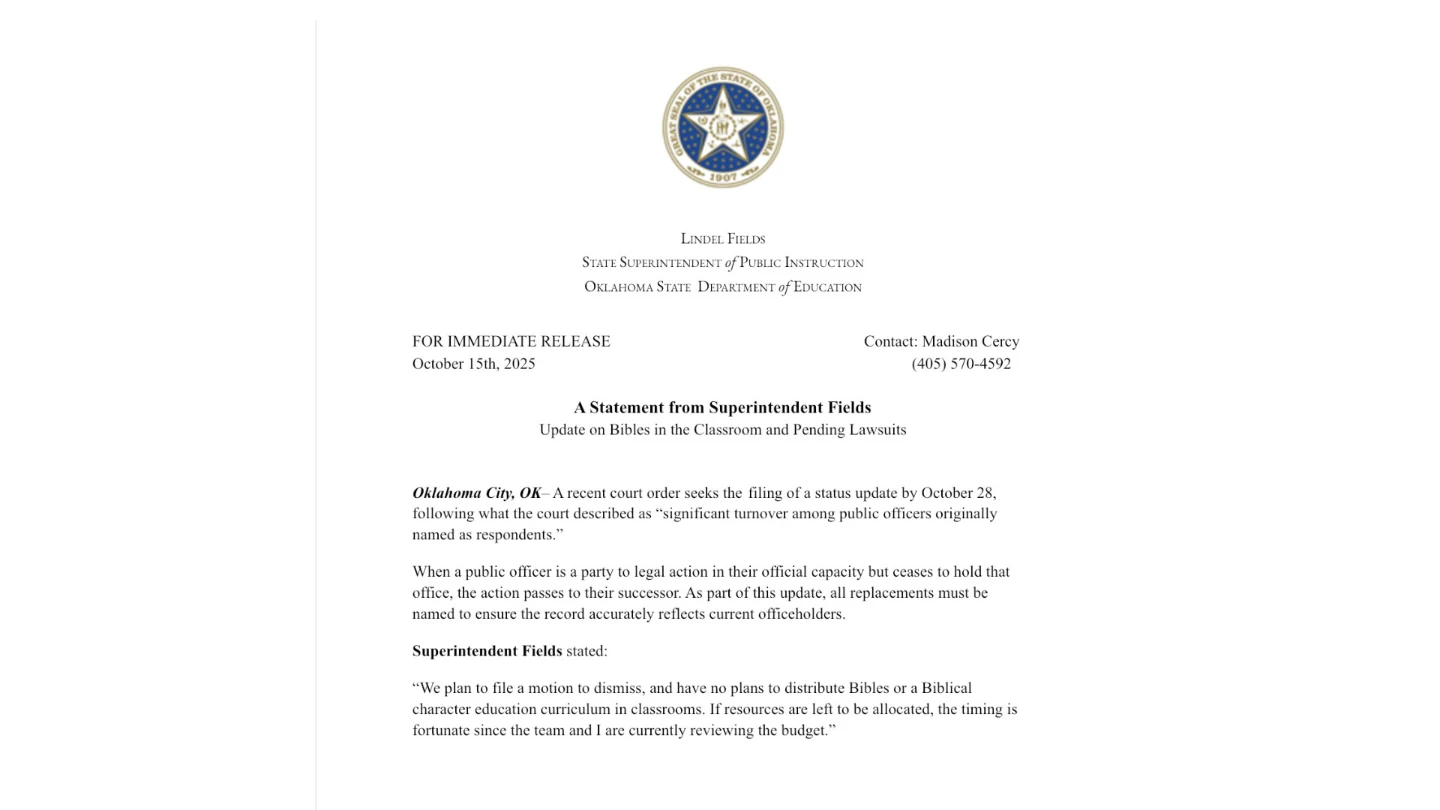
Oklahoma's new State Superintendent of Schools has announced he is reversing the policy of his predecessor Ryan Walters' plans to distribute Bibles to every Oklahoma classroom and incorporate Biblical stories into the curriculum. Walters' plans are the subject of pending litigation in the Oklahoma Supreme Court. In an October 15 press release captioned "Update on Bibles in Classroom and Pending Lawsuits", Superintendent Lindel Fields said in part:

A recent court order seeks the filing of a status update by October 28....

"We plan to file a motion to dismiss, and have no plans to distribute Bibles or a Biblical character education curriculum in classrooms....

News9 reports on these developments. [Thanks to Thomas Rutledge for the lead.]

Placing Patron Saint Statues on City Safety Building Is Enjoined

In Fitzmaurice v. City of Quincy, (MA Super. Ct., Oct. 14, 2025), a Massachusetts state trial court issued a preliminary injunction barring installation, while the case proceeds, on a newly built public safety building of two ten-foot bronze statues depicting the Catholic patron saints of police and firefighters. The suit, filed by taxpayers, was brought under Art. 3 of the state constitution which requires equal treatment of all religious sects. The court held that while the U.S. Supreme Court has rejected the Lemon test for federal Establishment Clause challenges, the Lemon test still applies to claims under Art. 2 and 3 of the Massachusetts Declaration of Rights. The court said in part:

The Complaint here plausibly alleges that the statues at issue convey a message of endorsing one religion over others.... The statues, particularly when considered together, patently endorse Catholic beliefs....

Defendants contend that the statues have a secular purpose of inspiring police officers and their display ... neither advance nor prohibit religion... [T]he mayor's professed secular purpose offers nothing more than semantics.... It is impossible to strip the statue of its religious meaning to contrive a secular purpose.... 

ACLU Massachusetts issued a press release announcing the court's decision. A WCVB News report carries photos of the statues in question.

Diocese Has Vested Right in Statute of Limitations That Has Run in Suit by Abuse Victim

In 2020, the New Hampshire legislature amended its statute of limitations by removing the limitation period for suits alleging sexual assault. In Ball v. Roman Catholic Bishop of Manchester, (NH Sup. Ct., Oct. 15, 2025), the New Hampshire Supreme Court held that a defendant has a vested right in a statute of limitations defense once the limitation period has run. Therefore, Art. I, Sec. 23 of the New Hampshire Constitution bars applying the 2020 amendment to claims where the prior limitation period had run before 2020.  In the case, plaintiff sued the Catholic diocese and Catholic camps alleging negligent hiring, retention, and supervision of an employee who sexually abused him when he attended camp in the 1970s.  AP reports on the decision. [Thanks to Thomas Rutledge for the lead.]

Thursday, October 16, 2025

Court Dismisses Religious Challenges to Trump's Executive Order on Portraying American History

In Jeanpierre v. Trump, (D UT, Oct. 14, 2025), a Utah federal magistrate judge dismissed a suit challenging on RFRA, free exercise and Establishment Clause grounds President Trump's Executive Order 14253, "Restoring Truth and Sanity to American History." Plaintiff is the founder of a religious organization called Black Flag whose tenets include prohibitions on prejudice and discrimination. The court said in part:

According to Mr. Jeanpierre, this executive order “effectively establishes a state sponsored religious doctrine of American historical exceptionalism” and, as a result, is “a direct attack on the foundational tenets of [his] sincerely held religious beliefs.” He alleges the order prevents Mr. Jeanpierre “from exercising his religious autonomy to perceive and interpret history according to his religious conscience.”  He alleges the order’s “prohibition against depicting American history as ‘inherently racist, sexist, oppressive, or otherwise irredeemably flawed’” impedes his “religious mandate to identify and confront . . . historical realities” and interferes with his “religious practice of acknowledging and addressing systemic racism” by “imposing a sanitized historical narrative that contradicts [his] religious understanding of reality.”  The “restrictions on historical presentations,” according to Mr. Jeanpierre, force “compliance with a historical narrative that [he] religiously believes causes harm to marginalized communities” and “spiritual suffocation and respiratory distress to [his] religion by restricting the free breath of historical truth.”  Finally, Mr. Jeanpierre alleges the executive order’s imposed historical doctrine compels him “to violate his religious tenants regarding autonomy, truth-telling, and confrontation of systemic inequity,” forcing him “to choose between adherence to his religious principles and compliance with federal law.” 

The court concluded that plaintiff failed to state a cause of action under §1983 which applies only to state officials, or under the Bivens doctrine that does not apply to 1st Amendment claims. The court also rejected plaintiff's RFRA claim, saying in part:

... [T]he executive order ... does not demand any conduct from Mr. Jeanpierre or impose any consequence for his religious beliefs.  It orders federal agencies to remove race-centered ideology from the Smithsonian Institution and to restore public monuments, according to President Trump’s historical narrative that the country’s achievements, principles, and milestones are being undermined and cast in a negative light.  Mr. Jeanpierre does not assert he was made to alter his religious behavior in some way because of this order. 

The court also rejected plaintiff's 1st Amendment claims, saying in part that the Executive Order is neutral and generally applicable and does not target religion.

Plaintiff Lacks Standing to Claim Rutgers Engaged in Anti-Hindu Discrimination

In Bagal v. Rutgers, the State University of New Jersey, (D NJ, Oct. 14, 2025), a New Jersey federal district court dismissed for lack of standing a suit claiming the university, in violation of the 1st and 14th Amendments, Title VI and New Jersey law, discriminated against plaintiff because of his Hindu religious beliefs. At issue is a Task Force Report recommending that the University add "caste" as a protected category in its antidiscrimination policy. The University rejected the recommendation, saying that its current policy is broad enough to protect against caste discrimination. Plaintiff claimed that the chair of the Task Force had a history of discriminatory animus toward the Hindu religion. The court said in part:

Defendants argue that Plaintiff alleges two distinct injuries...: (1) Defendants discriminated against Plaintiff for his religious beliefs because the Report connects an oppressive caste system with Hinduism; and (2) Plaintiff has refrained from engaging in certain religious activities and from discussing his religious beliefs in class....  Defendants argue that Plaintiff was only a remote participant in an online certificate program, so he has not suffered any concrete injury as a result of the Report’s publication, and that Plaintiff’s allegations of harm to other Hindu students at Rutgers is improper.... 

Here, Plaintiff has not pled facts to demonstrate how the Report—which cannot be and will not be enforced—is burdening Plaintiff’s ability to exercise his religious rights.  The Report was a non-binding recommendation that carries with it no disciplinary weight.  And Rutgers expressly declined to include the term “caste” in its Policy, so the complained of governmental action apparently burdening Plaintiff’s religious activities does not exist.  Stated differently, Plaintiff’s self-censorship is based on “hypothetical future harm that is not certainly impending.”...

Plaintiff cannot manufacture standing by alleging a stigmatic injury, when that alleged stigmatic harm is not objectively reasonable based on the allegations...Simply being offended by the Report and Truschke’s alleged statements connecting Hinduism to the caste system are insufficient, without more, to confer Plaintiff with standing to bring his Establishment Clause claim....

Wednesday, October 15, 2025

Supreme Court Denies Review of School Policy on Hiding Students' Gender Dysphoria from Parents

The U.S. Supreme Court yesterday denied certiorari in Lee v. Poudre School District R-1, (Docket No. 25-89, certiorari denied (10/14/2025) (Order List). In the case, parents of two 6th graders sued a Colorado school district for damages after their children were invited by teachers to a Gender and Sexuality Alliance meeting. After the meeting, one of the students decided that she was transgender and the other started to suffer from suicidal ideations. The parents claimed that the school's policy of discouraging disclosure to parents of a child's transgender status violates parents' substantive due process rights. The U.S. 10th Circuit Court of Appeals dismissed the suit because plaintiffs had not alleged the existence of a school policy that was the moving force behind their constitutional injury. Parents' petition for Supreme Court review framed the question presented as:

Whether a school district may discard the presumption that fit parents act in the best interests of their children and arrogate to itself the right to direct the care, custody, and control of their children

In denying certiorari, Justice Alito, joined by Justices Thomas and Gorsuch, filed a concurring Statement, saying in part:

I concur in the denial of certiorari because petitioners do not challenge the ground for the ruling below.  But I remain concerned that some federal courts are “tempt[ed]” to avoid confronting a “particularly contentious constitutional questio[n]”: whether a school district violates parents’ fundamental rights “when, without parental knowledge or consent, it encourages a student to transition to a new gender or assists in that process.”... Petitioners tell us that nearly 6,000 public schools have policies—as respondent allegedly does—that purposefully interfere with parents’ access to critical information about their children’s gender identity choices and school personnel’s involvement in and influence on those choices.... The troubling—and tragic—allegations in this case underscore the “great and growing national importance” of the question that these parent petitioners present....

CBS News reports on the Court's action

Monday, October 13, 2025

Death Row Inmate's RLUIPA Claim Rejected

In Shockley v. Adams, (ED MO, Oct. 11, 2025), a Missouri federal district court dismissed a death row inmate's RLUIPA lawsuit concluding that his religious exercise was not substantially burdened by a refusal to allow his daughters to be present in the execution chamber, administer communion, anoint him and pray over him there. Plaintiff has delayed his execution with decades of litigation. The court said in part:

Respondents claim that safety and security considerations, borne of their experience as corrections officials who have overseen several state-mandated executions, counsel strongly against allowing family members into the execution chamber....  Respondents have expressly agreed that Shockley’s daughters are welcome to be execution observers.  And, Respondents have offered various accommodations, including having a non-family minister of Shockley’s own choosing provide and perform the exact same religious sacraments and rituals that Shockley desires....

In finding that the accommodations Respondents have offered do not substantially burden Shockley’s free exercise of religion, the Court also emphasizes what’s not in the record: 

• Shockley does not assert that his daughters are his only spiritual advisors; 

 • Shockley does not assert that his daughters are the only ministers able or qualified to provide the religious sacraments and rituals he seeks;  

• Shockley does not articulate how the accommodations substantially burden, or burden at all, his exercise of religion. Instead, he leaves it to be assumed; 

• Shockley nowhere claims that he has a particularly unique spiritual bond with his daughters.  Again, he leaves it to be assumed.  

... Shockley has known of this issue for months and chose to file suit five days before his execution, so in this regard, the Court finds that Shockley’s delay and lack of development of the record are equitable considerations weighing against the extraordinary equitable relief of a stay of execution....

UPDATE: In Shockley v. Adams, (8th Cir., Oct. 13, 2025), the U.S. 8th Circuit Court of Appeals denied Shockley's motion for a stay of execution. On Oct. 13, Missouri Governor Mike Kehoe announced that he would not grant clemency to Shockley. In Shockley v. Adams, (Sup. Ct., Oct. 14, 2025), the U.S. Supreme Court denied Shockley's application for a stay of execution, denied certiorari, and permitted Respondent of file a supplemental appendix under seal. On Oct. 14, Shockley was executed. (CBS News).